
Evaluation Esodo Pratelli
Esodo Pratelli Valuations - Want to sell a Esodo Pratelli piece? Request a complimentary and confidential valuation!Colasanti Casa d'Aste will review your submission and offer a free-of-charge estimate, if your item is suitable for our auctions.
biography
Esodo Pratelli, born on February 8, 1892, in Lugo di Romagna, was an Italian painter, set designer, and film director, and a leading figure in 20th-century art. He began his training at the School of Drawing and Plastic Arts in Lugo before moving to Rome, where he attended the Academy of Fine Arts on Via Ripetta and came into contact with prominent artists such as Giacomo Balla and Mario Sironi. After an initial Symbolist phase, he embraced Futurism between 1913 and 1914 during a stay in Paris, also collaborating on the creation of sets and costumes for Futurist theatrical works, including L’Aviatore Dro by his cousin Balilla Pratella. Drafted into military service during World War I, he was discharged in 1919 and settled in Milan, where he held his first solo exhibition in 1922. In the 1920s, Pratelli held significant roles in the applied arts: he was appointed secretary of the Fascist Syndicate of Fine Arts in Milan and Lombardy, directed the Higher School of Applied Arts to Industry at the Castello Sforzesco from 1924 to 1934, and was actively involved in founding the Corporation of Plastic Arts. He joined the Novecento Italiano movement, being listed by Margherita Sarfatti among the group’s young talents, and participated in major national exhibitions, including the Venice Biennale and the Rome Quadriennale. In the late 1930s, Pratelli turned to cinema as a screenwriter and director, making films such as Pia de’ Tolomei, Se non son matti non li vogliamo, and A che servono questi quattrini? with Eduardo and Peppino De Filippo. He became an executive at Cinecittà, the Centro Sperimentale di Cinematografia, and the Film Censorship Commission. After the war, he returned to painting with a more essential style, as seen in his 1967 work La scatola delle cose dimenticate. He died in Milan on January 4, 1983, leaving behind an eclectic artistic legacy now preserved in museums, galleries, and public and private collections.
Past lots of Esodo Pratelli
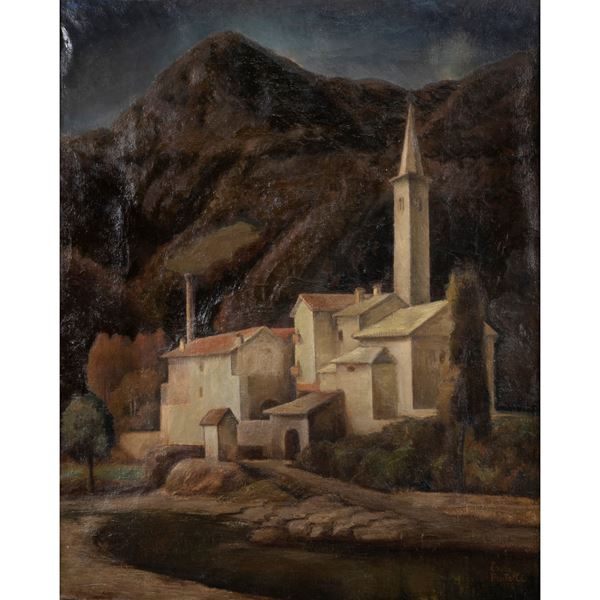
Esodo Pratelli
(Lugo, 1892 - Milano, 1983)
'Scorcio di paese'
oil on canvas, signed and dated on the bottom right, within frame Provenance: Private collection, Rome Exhibitions: "Prima [..]
Sold