
Evaluation Vittorio Zecchin
Vittorio Zecchin Valuations - Want to sell a Vittorio Zecchin piece? Request a complimentary and confidential valuation!Colasanti Casa d'Aste will review your submission and offer a free-of-charge estimate, if your item is suitable for our auctions.
biography
Vittorio Zecchin (Murano, May 21, 1878 – Murano, April 15, 1947) was a major Italian artist, painter, draftsman, and a leading figure in the renewal of Venetian decorative arts in the early 20th century. Son of Luigi, a Murano glass technician, Zecchin left technical schools to enroll at the Academy of Fine Arts in Venice, where he studied under Augusto Sezanne. Drawn to Symbolist research and the Viennese Secession, he blended Klimtian stylistic elements with the color and light of the Venetian tradition, creating works with synthetic linearism and vibrant chromaticism, such as the triptych Salomé (1911-13) and Perla orientale (1913). In 1914, he was among the artists rejected by the Venice Biennale and created the decorative cycle Le Mille e una notte for the Hotel Terminus, considered the masterpiece of Liberty painting in Venice. Increasingly interested in applied arts, during World War I he established a workshop in Murano for tapestries and embroidery, developing an innovative technique (“punto mio”) that imitated brushstrokes. From 1921 to 1925, he was artistic director of the Cappellin Venini glassworks, designing modern and refined glass pieces that marked a turning point in Murano production. In the 1930s, he dedicated himself to teaching at Venetian professional institutes, including the Murano Glass Industry School and the Abate Zanetti school, publishing booklets on the history of glass and mosaic. Vittorio Zecchin is buried in Murano, where a monument sculpted by Napoleone Martinuzzi was erected in his honor.
Past lots of Vittorio Zecchin
Vittorio Zecchin
(Italia, 1878 - Italia, 1947)
Vittorio Zecchin (1878 - 1947)
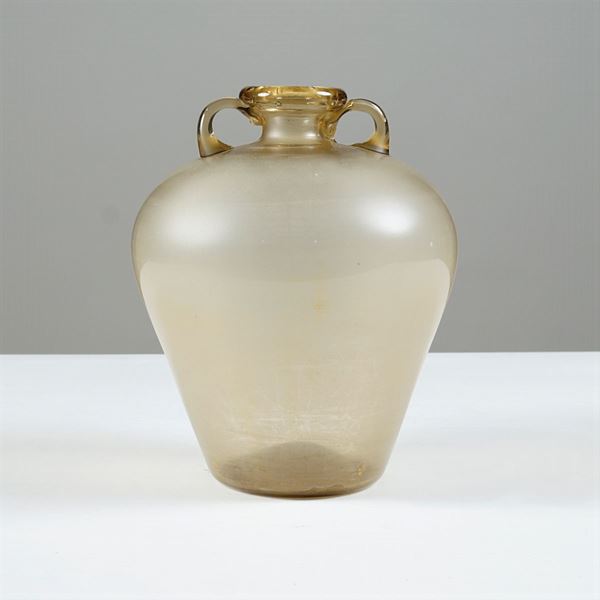
yellow blown glass vase with handles, h. 19 cm.
Sold
Vittorio Zecchin
(Italia, 1878 - Italia, 1947)
Vittorio Zecchin
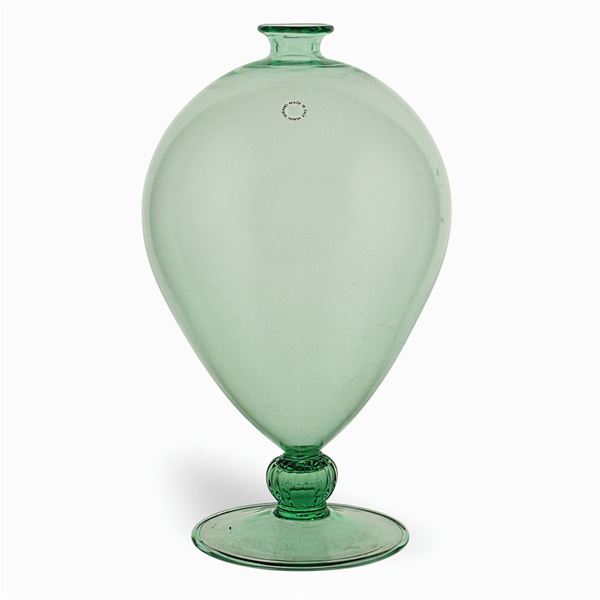
vase from the 'Veronese' series, green blown glass, 'Venini 91' signature under the base, 'Venini Muranoì [..]