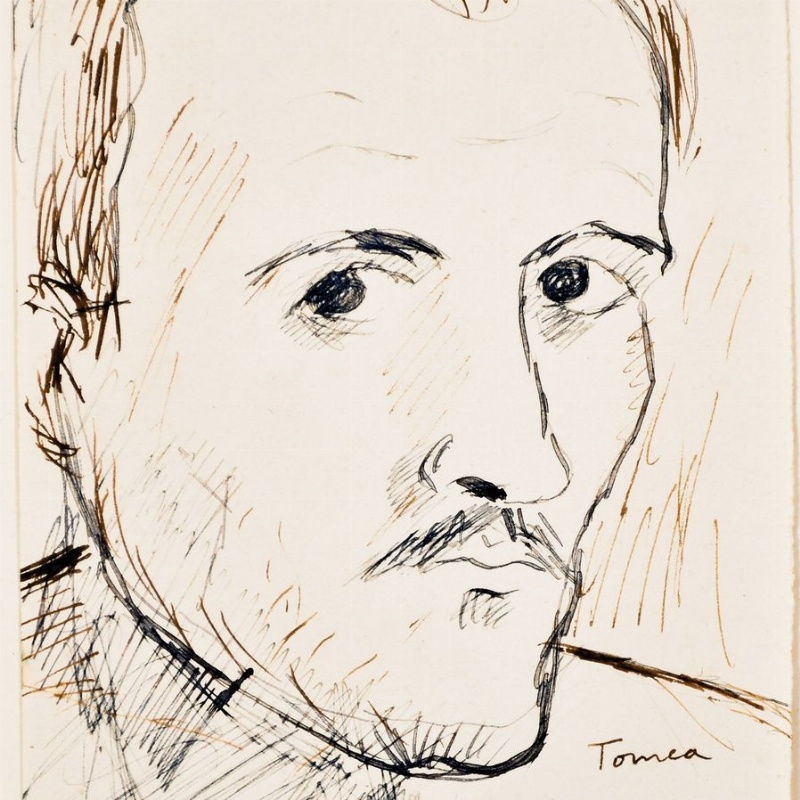
Evaluation Fiorenzo Tomea
Fiorenzo Tomea Valuations - Want to sell a Fiorenzo Tomea piece? Request a complimentary and confidential valuation!Colasanti Casa d'Aste will review your submission and offer a free-of-charge estimate, if your item is suitable for our auctions.
biography
Fiorenzo Tomea (Zoppé di Cadore, February 7, 1910 – Milan, November 16, 1960) was an Italian painter of the 20th century, known for his expressive style and a personal formal simplification with primitive influences. The youngest of ten children, his childhood was marked by poverty and the early loss of his father, which forced him to leave the mountains of Cadore at the age of twelve and move to Milan, where he began working in various trades. Despite these hardships, his passion for painting emerged early, thanks also to the encounter with the Veronese painter Masotto, who gave him his first colors.
In 1926 he moved to Verona, where he attended evening courses at the Accademia Cignaroli and became friends with artists such as Sandro Bini, Renato Birolli, and Giacomo Manzù. Returning to Milan, he met key figures of the Italian art scene, including Aligi Sassu, Bruno Cassinari, Domenico Cantatore, and Francesco Messina. The meeting with critic Edoardo Persico was crucial for his artistic development: through him, Tomea became acquainted with the works of Carlo Carrà, Ottone Rosai, metaphysical painting, Impressionism, Paul Cézanne, and the letters of Vincent van Gogh.
His artistic production is rich in recurring themes: Dolomite landscapes tinged with melancholy, still lifes of flowers or domestic objects, compositions of candles and masks. During the Second World War, he focused on subjects of displaced people and emigrants, depicting a sorrowful and wandering humanity. From the immediate postwar period, sacred themes became predominant, with works such as the Crucifixion of Christ and religious still lifes, which earned him recognition in the Vatican Museums.
In 1926 he moved to Verona, where he attended evening courses at the Accademia Cignaroli and became friends with artists such as Sandro Bini, Renato Birolli, and Giacomo Manzù. Returning to Milan, he met key figures of the Italian art scene, including Aligi Sassu, Bruno Cassinari, Domenico Cantatore, and Francesco Messina. The meeting with critic Edoardo Persico was crucial for his artistic development: through him, Tomea became acquainted with the works of Carlo Carrà, Ottone Rosai, metaphysical painting, Impressionism, Paul Cézanne, and the letters of Vincent van Gogh.
His artistic production is rich in recurring themes: Dolomite landscapes tinged with melancholy, still lifes of flowers or domestic objects, compositions of candles and masks. During the Second World War, he focused on subjects of displaced people and emigrants, depicting a sorrowful and wandering humanity. From the immediate postwar period, sacred themes became predominant, with works such as the Crucifixion of Christ and religious still lifes, which earned him recognition in the Vatican Museums.
Past lots of Fiorenzo Tomea
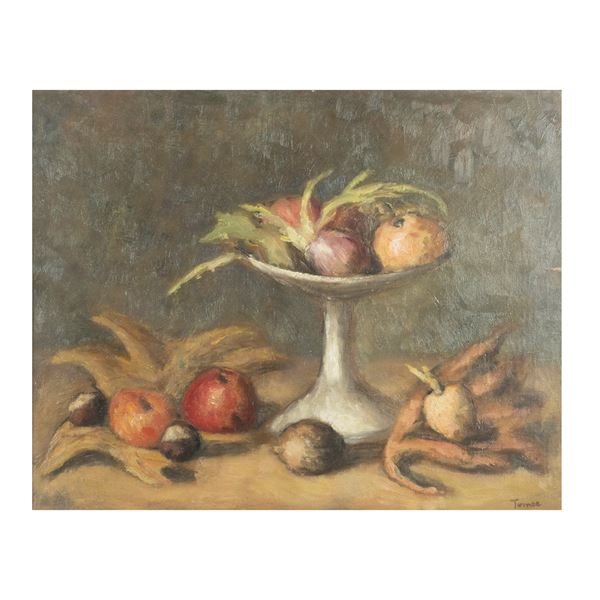
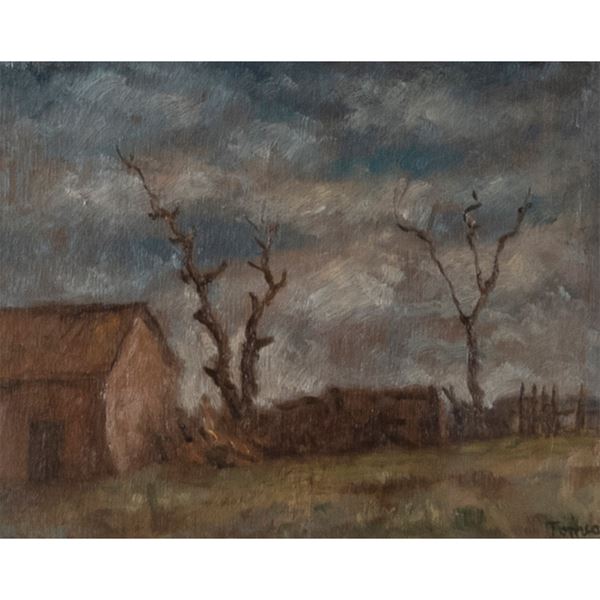
Fiorenzo Tomea
(Zoppé di Cadore, 1910 - Milano, 1960)
"Fruit bowl with leaves"
oil on canvas, signed lower right, signed, dated and titled on the back, within frame
Provenance: Galleria Il Camino, Roma [..]
Sold
Fiorenzo Tomea
(Zoppé di Cadore, 1910 - Milano, 1960)
'Houses in Umbria'
oil on panel, signed lower right, signed, titled and dated on the back, within a frame Provenance: Galleria dell'Annunciata, [..]
Sold