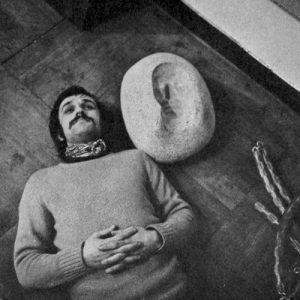
Evaluation Alighiero Boetti
Alighiero Boetti Valuations - Want to sell a Alighiero Boetti piece? Request a complimentary and confidential valuation!Colasanti Casa d'Aste will review your submission and offer a free-of-charge estimate, if your item is suitable for our auctions.
biography
Alighiero Boetti, born in Turin in 1940 and died in Rome in 1994, was one of the most influential figures in Italian art of the second half of the twentieth century. A leading member of the Arte Povera movement, Boetti distinguished himself from the 1960s onward for his conceptual vision and his ability to experiment with innovative techniques and materials. After leaving university studies, he approached art in a self-taught manner, developing an early interest in music, mathematics, philosophy, and Eastern culture. His intellectual formation was enriched by reading authors such as Hermann Hesse and Paul Klee, as well as by exploring esoteric and alchemical themes.
Boetti is best known for his conceptual works, including tapestries, world maps, and series of embroideries created in collaboration with Afghan artisans. His ‘Maps’ have become icons of contemporary art, recording geopolitical changes through the repetition and variation of graphic elements. The artist often delegated the execution of his works to others, emphasizing the role of chance and necessity, and challenging the traditional concept of authorship. Among his most celebrated techniques are ballpoint pen drawings, collages, and portfolios of serigraphs.
In 1971, Boetti began signing his works as ‘Alighiero e Boetti’, marking a turning point in his artistic identity. After moving to Rome, he intensified his travels to Afghanistan, where he established a lasting collaboration with local craftswomen. His production is characterized by a wide range of themes, ranging from geometry and seriality to self-reflection, Arab culture, and African influences. Boetti is considered one of the founders of Arte Povera, but he always maintained an independent position within the group, standing out for his versatility and his ability to continually innovate the artistic language.
Boetti is best known for his conceptual works, including tapestries, world maps, and series of embroideries created in collaboration with Afghan artisans. His ‘Maps’ have become icons of contemporary art, recording geopolitical changes through the repetition and variation of graphic elements. The artist often delegated the execution of his works to others, emphasizing the role of chance and necessity, and challenging the traditional concept of authorship. Among his most celebrated techniques are ballpoint pen drawings, collages, and portfolios of serigraphs.
In 1971, Boetti began signing his works as ‘Alighiero e Boetti’, marking a turning point in his artistic identity. After moving to Rome, he intensified his travels to Afghanistan, where he established a lasting collaboration with local craftswomen. His production is characterized by a wide range of themes, ranging from geometry and seriality to self-reflection, Arab culture, and African influences. Boetti is considered one of the founders of Arte Povera, but he always maintained an independent position within the group, standing out for his versatility and his ability to continually innovate the artistic language.
Lots up for auction of Alighiero Boetti

Alighiero Boetti
(Torino, 1940 - Roma, 1994)
"Dodici forme dal 12 giugno 1967"
folder containing twelve silk-screen prints on cardboard, e.g. nd., signed lower right, Edizioni Grafiche Artestudio Macerata, [..]
Past lots of Alighiero Boetti

Alighiero Boetti
(Torino, 1940 - Roma, 1994)
'Dodici forme dal 12 giugno 1967'
folder containing twelve silk-screen prints on cardboard, e.g. nd., signed lower right, Edizioni Grafiche Artestudio Macerata, [..]
Sold