
Evaluation Armando Spadini
Armando Spadini Valuations - Want to sell a Armando Spadini piece? Request a complimentary and confidential valuation!Colasanti Casa d'Aste will review your submission and offer a free-of-charge estimate, if your item is suitable for our auctions.
biography
Armando Spadini, born in Florence on July 29, 1883, was one of the leading figures of the Roman School and one of the most significant Italian painters of the early 20th century. Son of an artisan and a seamstress, he grew up in a modest family and showed a remarkable talent for drawing from an early age. His father apprenticed him as a decorator at Jafet Torelli's artistic ceramics factory, but soon Armando attended the professional school of industrial decorative arts in Florence, where he studied engraving and painting. There, he met artists such as Ardengo Soffici and Giovanni Fattori, who deeply influenced his artistic education. Spadini quickly distinguished himself for his ability to blend the Florentine tradition with new currents such as symbolism and impressionism, earning him the reputation as the Italian heir to Pierre-Auguste Renoir.
In 1910, thanks to a national scholarship, Spadini moved to Rome, where he married Pasqualina Cervone, a painter and his future muse. In Rome, his painting was characterized by the luminous use of color and the depiction of everyday scenes and portraits, earning him important recognition and participation in prestigious exhibitions such as the Roman Secession, the Venice Biennale, and the Roman Quadriennale. Despite his short life, Spadini left an indelible mark on Italian art, with a rich production of works expressing a classicist naturalism and refined chromatic sensitivity. He died in Rome in 1925, but his artistic legacy was celebrated with retrospectives and posthumous exhibitions, including a dedicated room at the Venice Biennale in 1924 and a retrospective at the first Roman Quadriennale in 1931.
Armando Spadini is now considered a master of Italian impressionism, appreciated for his ability to capture light and the beauty of nature and everyday life.
In 1910, thanks to a national scholarship, Spadini moved to Rome, where he married Pasqualina Cervone, a painter and his future muse. In Rome, his painting was characterized by the luminous use of color and the depiction of everyday scenes and portraits, earning him important recognition and participation in prestigious exhibitions such as the Roman Secession, the Venice Biennale, and the Roman Quadriennale. Despite his short life, Spadini left an indelible mark on Italian art, with a rich production of works expressing a classicist naturalism and refined chromatic sensitivity. He died in Rome in 1925, but his artistic legacy was celebrated with retrospectives and posthumous exhibitions, including a dedicated room at the Venice Biennale in 1924 and a retrospective at the first Roman Quadriennale in 1931.
Armando Spadini is now considered a master of Italian impressionism, appreciated for his ability to capture light and the beauty of nature and everyday life.
Past lots of Armando Spadini
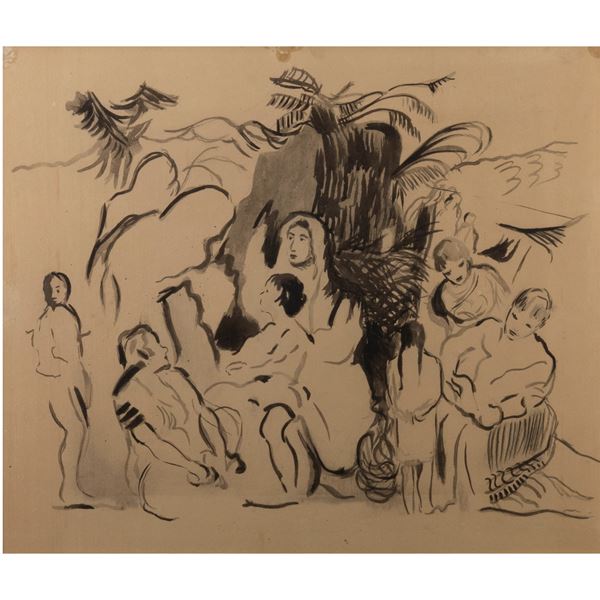
Armando Spadini
(Firenze, 1883 - Roma, 1925)
"Mosè salvato dalle acque"
watercolor on paper, framed
Provenance: Private collection, Rome
Sold